
Menus · September 2, 2026
Cold Catering vs. Hot Meals on Private Jets: Which Should You Order?
Cold and hot both work. Which one works for you depends on your aircraft, flight time, and service style.

The Quick Answer
Cold catering works best for: Short flights (under 3 hours), private jets without heating elements, quick turnarounds, and budget conscious orders.
Hot meals work best for: Long-range flights, VIP service, large cabin jets with galleys, and when you want bespoke dining at altitude.
But the real answer depends on four factors and we'll walk through all of them below.
Why This Decision Matters (More Than You Think)
When you're ordering private jet catering, this choice affects three real operational things:
1. Service Timing During Flight: Cold meals are ready to serve immediately after boarding. Hot meals need 15-20 minutes to reheat and plate during flight. If you want service to start shortly after wheels-up, cold is the better option. Hot meals means a delayed service window.
2. Kitchen Availability & Lead Time: Cold items are assembly work, kitchens can turn them out same-day, even on 2-hour notice. Hot meals require actual cooking, so most caterers need 12-24 hours minimum. If you're booking flights short notice or last-minute changes happen, cold is what's actually available. Hot requires you to plan ahead.
3. Aircraft Capability: Some private jets have no galley or no heating element like a microwave or oven. If your aircraft can't reheat, ordering hot meals is pointless as they'll arrive cold anyway, unless you plan on reheating them using the FBO’s kitchen before the pax arrive. You need to know your aircraft before deciding.
Factor #1: Flight Duration
This is a major factor. Here's how it breaks down:
Flights Under 3 Hours → Cold Catering (Usually)
- ·Passengers don't expect a full meal
- ·Reheating time doesn't make sense
- ·Cold salads, sandwiches, charcuterie travel better
- ·Cost is typically lower
- ·No galley equipment needed
Example: New York to Miami (3.5 hours) | Order cold antipasti, sandwiches, fruit. Passengers board, service is quick, no complexity.
Flights 3-6 Hours → Either Works (Depends on Other Factors)
- ·Hot meals are nice but not necessary
- ·Cold is still professional
- ·If you choose hot: needs a galley and flight attendant
- ·If you choose cold: can go higher-end (sushi, premium cheeses, composed salads)
Example: New York to Cancun (4.5 hours) | You could do cold gourmet appetizers or hot entrées. Both work. Cold is simpler, hot is more luxe.
Flights 6+ Hours → Hot Meals (Usually)
- ·Passengers expect restaurant-quality service
- ·Cold food gets boring over 8+ hours
- ·You have time to reheat properly
- ·Heavy jets on international routes have galleys
- ·VIP expectation on long-range flights
Example: New York to London (7 hours) | Order a multi-course hot meal with appetizers, main, sides, dessert. Crew finishes preparation inflight.
Factor #2: Aircraft Type & Galley Equipment
This is non-negotiable. Your aircraft determines what's physically possible.
Light Jets & Turboprops (Phenom 300, King Air, Pilatus PC-12, Citation Ultra)
- ·Galley: Minimal or none
- ·Heating: Microwave at best, can only reheat so many things at once
- ·Reality: Cold catering is usually best, or pre-heated food from FBO. Usually no FA on board to reheat or plate the items.
- ·Best option: Cold meals (sandwiches, salads, fruit, cheese, pastries)
- ·What doesn't work: High quantity of hot entrées, reheated proteins. Items that need to be assembled by FA
Tip: Light jets & prop planes are typically short-haul flights without a flight attendant, so order cold meals that are already plated and ready to eat and not components passengers have to assemble. Think individual charcuterie boxes or composed salads, not boards they have to make sandwiches from. Presentation matters because there's no crew to plate it nicely inflight.
Midsize Jets (Hawker 800, Learjet 75, Citation XLS)
- ·Galley: Limited, microwave or small oven
- ·Heating: Usually Microwave capability
- ·Reality: Heated items must be pre-packaged for microwave
- ·Best option: Cold as primary; heated appetizers if absolutely necessary
- ·Limitation: Minimal plating inflight, everything comes packaged
Tip: Communicate your heating element size to your caterer so they can optimize packaging to be able to reheat as much as possible at once as these jets usually carry a higher pax count on each trip.
Super-Midsize & Heavy Jets (Challenger 350, Citation X, Gulfstream G550/G650)
- ·Galley: Full galley with convection oven
- ·Heating: Professional grade reheating
- ·Reality: Flight attendant can plate and finish dishes inflight
- ·Best option: Hot meals, multi-course service
- ·Flexibility: Can do both cold appetizers AND hot mains
Tip: Large cabin jets carry higher passenger counts, so order quality that matches. Specify oven-safe packaging over microwave as convection ovens reheat proteins and sauces better than microwaves.
Factor #3: Service Style & Crew Capability
How different types of service can affect how you order food for a private jet.
Self-Serve / Casual Service
- ·Passengers help themselves from boards/platters
- ·No flight attendant required (or minimal involvement)
- ·Cold works great here. No plating, no timing complexity
- ·Examples: charter groups, business travel, tight budgets
- ·Order: Charcuterie boards, composed salads, sandwich boxes
Butler Service / Seated Service
- ·Flight attendant plates and serves each passenger
- ·Formal dining feel
- ·Typically requires either hot (for plating presentation) or premium cold (composed plates)
- ·Examples: executive travel, VIP clients, formal events, longer haul flights
- ·Order: Hot multi-course or pre-plated premium cold
Overnight Service (Dinner + Breakfast)
- ·Dinner service during cruise (hot preferred)
- ·Passengers sleep mid-flight
- ·Breakfast/coffee available on approach
- ·Requires planning for both hot and cold across service windows
- ·Examples: international long-haul, red-eyes
Why Hot for Dinner:
You're on a heavy jet with full galley capability (international flights require this). You have 8+ hours of lead time to order. Passengers have appetite after boarding and settling in. Hot dinner feels premium and justified on a 7+ hour flight. The galley crew has time to prep and plate properly during cruise when workload is light.
Why Fresh Breakfast Instead of Pre-Made:
Reheated eggs are rubbery and disappointing. Order raw ingredients instead like eggs, butter, fresh bread, cheese and have the flight attendant cook fresh scrambled or omelets to order during descent. Takes 10 minutes, tastes high quality, and passengers notice. Pair with cold items (yogurt, fruit, juice, pastries) that need no prep.
Order: Hot multi-course dinner (filet, seafood, sides) + raw breakfast ingredients (eggs, butter, bread, cheese) + cold items (yogurt, fruit, juice, pastries)
How to Elevate Cold Catering When You Are Without A Heating Element:
Here's the truth: cold meals feel cheap when you order them cheap. But premium cold actually looks better than mediocre hot.
The difference isn't the temperature. It's the menu creativity and the plating.
What Actually Makes Cold Feel Premium
Don't order sandwiches. Order things that restaurants charge $40+ a plate for because they're supposed to be cold.
Think sushi, tartare, charcuterie, composed salads. Things where cold is the feature, not the limitation.
Real Examples of Elevated Cold:
Instead of "turkey sandwich," order:
- ·Smoked salmon canapés — house-cured salmon on crisp toast points with crème fraîche and fresh dill
- ·Prosciutto di Parma with burrata — aged ham, fresh burrata, heirloom tomato, basil oil
- ·Composed steak salad — chilled filet mignon, arugula, crispy shallots, blue cheese, red wine vinaigrette (on the side)
Instead of "garden salad," order:
- ·Beet and goat cheese — roasted beets, creamy goat cheese, candied walnuts, aged balsamic
- ·Tuna tartare — sushi-grade tuna, avocado, crispy wonton, wasabi mayo, sesame
- ·Crab salad — lump crab, fennel, citrus vinaigrette, crispy capers
Instead of "cheese and crackers," order:
- ·Artisan cheese trio — aged Manchego, creamy Époisses, soft-ripened Brie with quince paste and marcona almonds
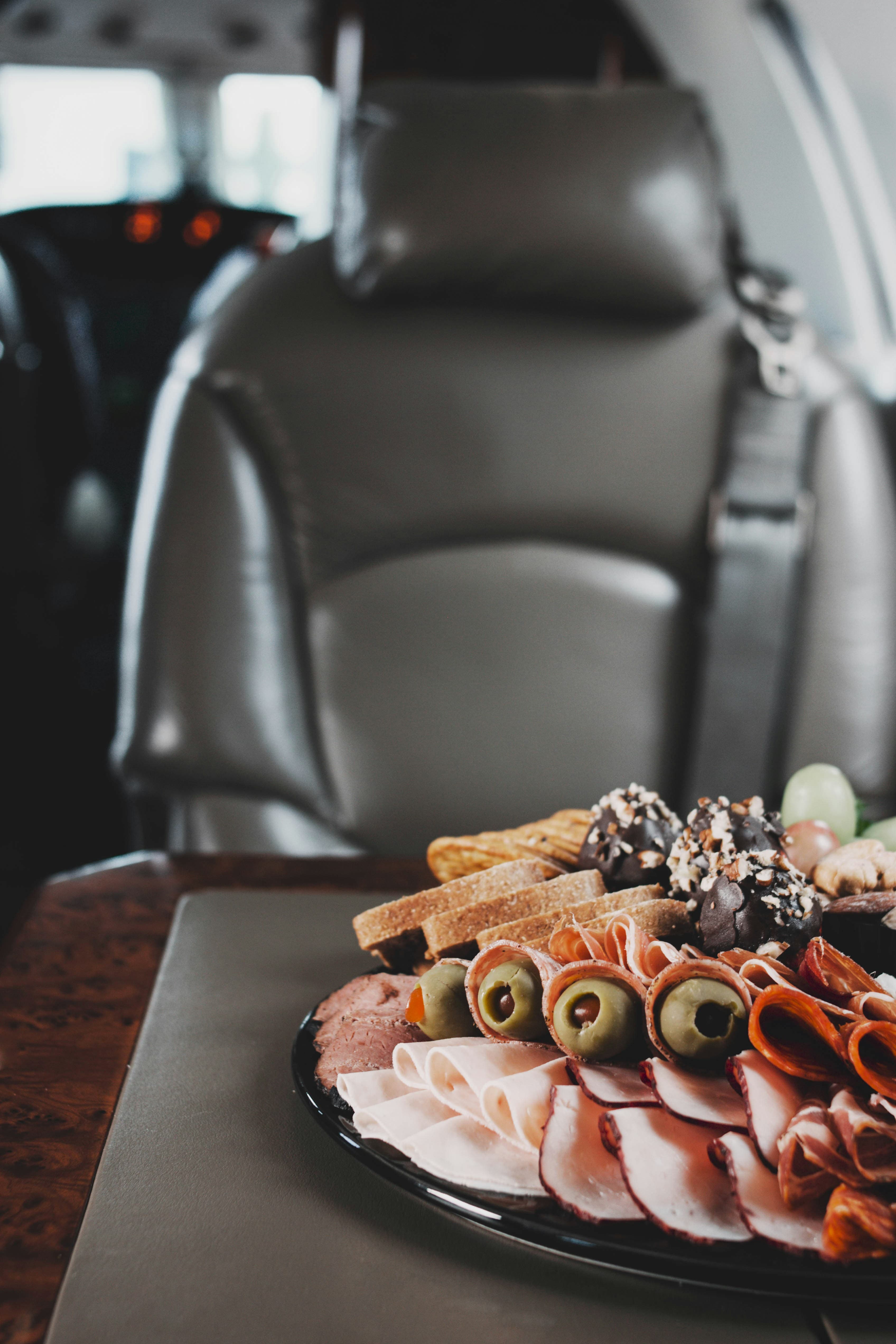
- ·Charcuterie curated — prosciutto, soppressata, duck prosciutto, aged saucisson, cornichons, housemade mustard
Instead of "apple and cookie," order:
- ·Dark chocolate tart with fresh berries — just elegant
- ·Crème brûlée cups — travels fine, tastes incredible
- ·Fresh fruit plate — heirloom tomatoes? Fresh figs? Pineapple? Whatever's in season and premium
Tip: Labeling matters. Little cards that say "Smoked Scottish salmon with house-cured mustard" looks intentional. Unlabeled stuff looks like you grabbed it at the last minute.
Flavor at Altitude: Why This Matters
You've probably heard: "Food tastes bland at altitude."
It's true. Cabin pressure dulls taste by 30-50%. Salt and spice receptors work differently.
For Cold Catering:
- ·Order bold flavors (cured meats, aged cheese, truffle oil, citrus)
- ·Subtle flavors (delicate fish, cream sauces) get lost
- ·Acidic foods work well (vinaigrettes, citrus, fresh herbs)
For Hot Catering:
- ·Professional caterers know this and over-season deliberately
- ·Mains with sauce > dry proteins
- ·Spiced dishes (curry, chimichurri, bold seasonings) work better
- ·Ask for extra salt/pepper on the side
The Final Decision:
Whether cold can feel luxe depends on your actual constraints. You have limited time? Cold works great if you source right. Long international flight where passengers expect hot? Maybe cold appetizers + hot main makes sense. Light jet with zero galley? Cold is your only move, so order the premium cold.
The point isn't "cold beats hot." It's: cold gets overlooked because people default to mediocre cold instead of premium cold. If you're going cold, commit to it. Order like a restaurant chef would order for a cold plate, not like you're grabbing lunch.
If you have the aircraft capability, lead time, and budget for hot, do it. But don't do mediocre hot just because you think hot is inherently better. A composed steak salad and fresh espresso will out-impress rubbery reheated chicken every time.
Keep reading.
All posts →
Ready to dispatch